Annual Birdwatching Bonanza, Sunday January 18th 2026
The weather forecast for the day did not bode well as we left our North Devon car park to go on our annual bird trip to Dart’s Farm, under grey skies and drizzly rain. Travelling along the Link road an overhead red kite brightened our journey a little. On arrival our numbers more than doubled with those members who made their own way to the venue. One member gathered two similar leaves from nearby red dead nettle plants. Closer inspection showed one of them to be from a cut leaved dead nettle. Meanwhile the rain had become heavier so it was decided to drive down to the bird hide rather than walking and then park in the fisherman’s car park.
Arriving at the bird hide we frightened off a cormorant fishing on an adjacent pond. This was probably good news for the resident fishermen who seemed to indulge in their pastime in all weathers. Later a moorhen created a kerfuffle as it crashed in to land on the same pond sending plumes of water at regular intervals nearly spanning the whole pond.
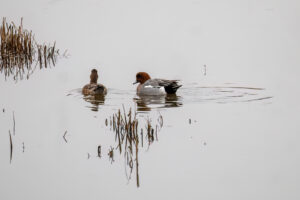
The rain eased slightly as we drove around to the Goosemoor reserve. Looking through the viewing gaps in the open air viewing hide we could see some teal on the mud banks and a lone mute swan relaxing amongst the vegetation.
There were not too many photographic opportunities for the keen photographers in our group, but they were seen taking close ups of lichens on nearby trees. Often in this spot a mistle thrush is seen on a tall tree loaded with mistletoe but not so this year, although we were compensated by the melodic singing of a song thrush. One of our group who decided to walk to Goosemoor reported seeing very few birds but something he had not witnessed before, a pair of mating foxes..
On then to the hide at Bowling Green Marsh where we ate our packed lunches whilst admiring the usual array of waterfowl in front of us. More difficult to spot were several snipe dotted around on the islands. In the distance a marsh harrier glided back and forth across the reed beds.
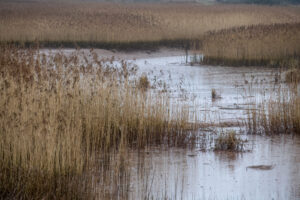
Lunch over, it was onwards to the viewing platform overlooking the River Clyst. Here we saw common gulls and a common sandpiper and most interestingly a pair of little egrets shuffling their feet around the weed covered stones in the shallows hoping to catch their lunch with a quick dart of their beaks.
Walking back along the muddy path we passed a birch tree loaded with it’s catkins and plenty of ivy with berries providing much needed Winter food for the birds. A small flock of greenfinches flew into a nearby hedge behind which Canada geese were grazing.
Now down to the Goat Walk where a turnstone was seen amongst the shoreline rocks. Although the rain had eased a splendid array of multi coloured umbrellas passed us as we stood looking out over the mud flats at the avocets. These are the birds adopted by the RSPB for their logo, looking elegant as they swished their upturned beaks from side to side seeking by touch worms and crustaceans to eat. With their thin beaks, long thin legs and slender bodies they are the ballerinas of the mudflats.
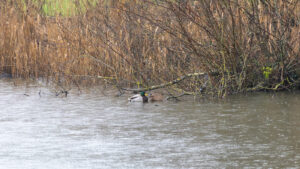
Heading back to our cars in the descending gloom we passed a small flock of great tits. A young dogwood tree looked splendid displaying its bare red branches. The leafless branches of a honeysuckle along a long stretch of hedge was still showing off its bright red berries.
Nothing left to do now but to retire to a nearby cosy pub for a warming and refreshing coffee.
Home now to watch Countryfile which would you believe, came from the Exe estuary. JS
Annual Indoor Meeting Thursday February 12th, 2026.

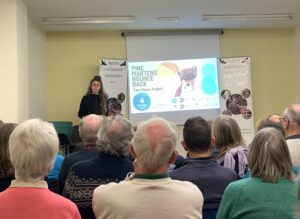
The annual Indoor meeting was very well attended as always. Ali North gave a superb talk on the release of Pine Martens onto Dartmoor and Exmoor. The Grey Squirrel population is apparently being effectively controlled by these predators. Ali said that each of the pine martens has a unique bib pattern which helps the team to identify each individual that is released into the wild. A collection of photographs of their bibs she lovingly called her ‘bibliography’. Radio collars also assist with monitoring the pine martens that have been released.
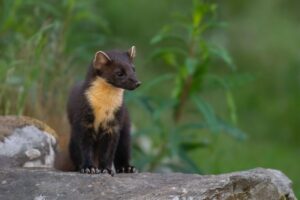
This is an ongoing project and pine martens are bouncing back with the Two Moors Pine Marten Project. Pine martens have been missing from our countryside for 150 years but to find out more or to take part visit www.twomoorspinemartens.org.
It was a fascinating talk. The raffle and teas, coffees and biscuits were held in the break with lots of prize winners! We couldn’t have the book stall this time as we needed the space for extra chairs. The picture of Ali giving her talk shows the front few rows, but the whole room was packed. It was a successful evening and we would like to thank our Chairman Brian Sims for organising, and the helpers Mandy, Ali, Sandy and the team as well as Ali North for her fascinating talk. EB